
Technical resources
Bubbles in a Casting Mix: A Deaeration Investigation for Oral Film Teams
Visible bubbles can originate in mixing, sampling or transfer. A useful investigation follows the same casting mix through those stages, distinguishes air from solids and checks whether a proposed deaeration step changes the formulation being coated.
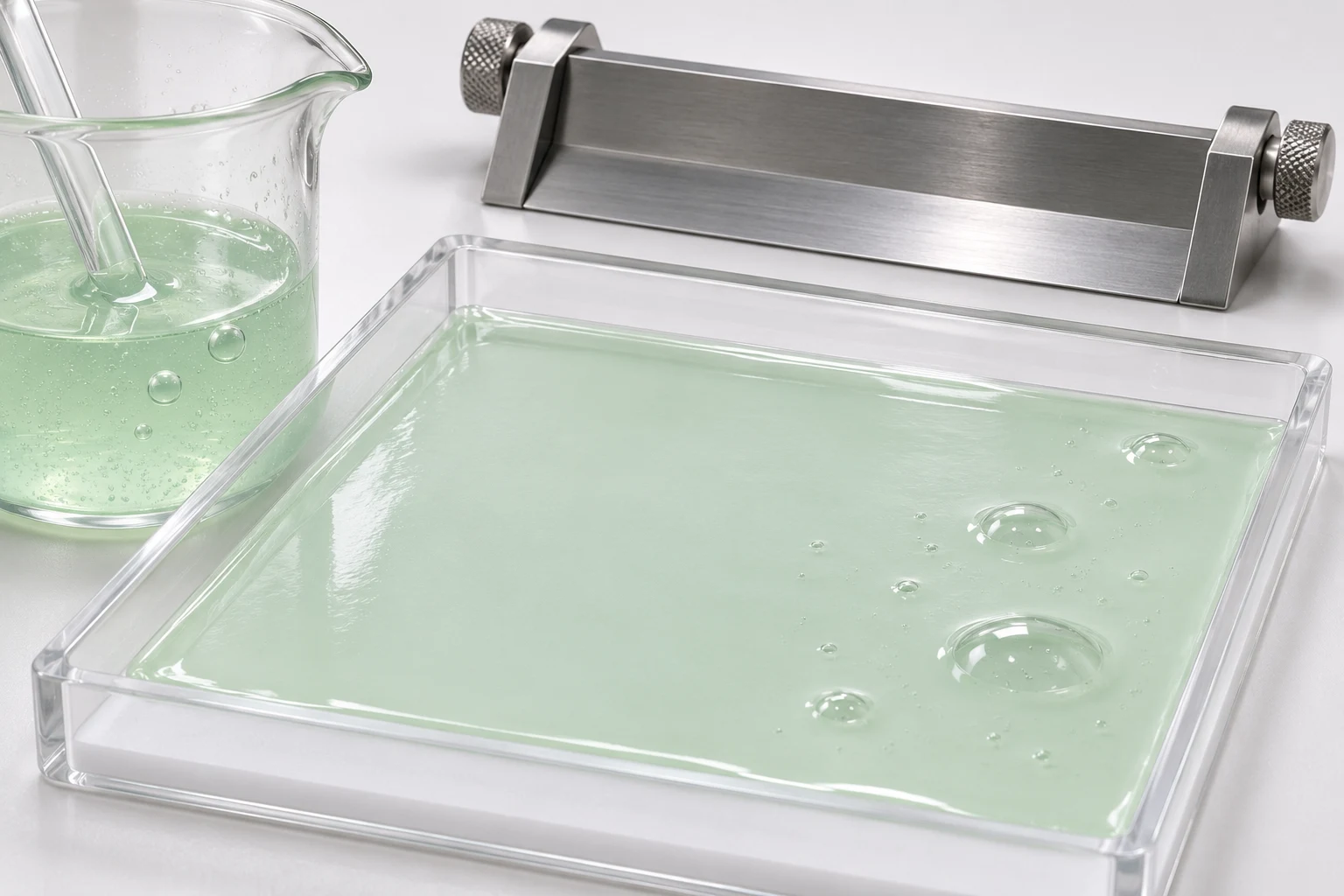
When pinholes appear in a trial film, extending the deaeration step is an understandable response. First establish where the suspect features arise. A quiet vessel surface can coexist with air entering downstream, and a particle seen through a translucent mix can be mistaken for a bubble. The investigation needs matched observations along the casting path.
Follow one mix from vessel to wet film
Choose defined observation points after mixing, after any deaeration step, at transfer discharge and immediately after coating. Collect samples with a consistent technique that does not deliberately introduce air. Record elapsed time, sample temperature and whether the material was recirculated. Photograph a comparable sample depth under the same lighting; photographs taken through different container widths are difficult to compare.
Observe whether the feature changes shape, moves or persists during the defined observation period. Those observations can help select a follow-up examination, but they do not identify an unknown inclusion conclusively. If visible material remains uncertain, retain it for microscopy or another suitable identification method instead of classifying every spot as air.
Compare treatments without changing the whole trial
A small study can compare untreated mix with a proposed deaeration treatment while keeping composition, sample age and casting conditions matched. Define the treatment through its actual operating conditions and equipment, not a label such as standard vacuum. The process owner should select safe conditions for the solvent system and vessel.
Published film research provides examples, not transferable recipes. A study of metoclopramide buccal films used an ultrasonic bath to remove entrapped bubbles before casting. That demonstrates one study-specific approach. It does not establish that ultrasound, its duration or its thermal exposure suits a different nutrition film or sensitive ingredient.
Track the mix before and after treatment. Include container mass where evaporation is a concern, and record temperature and the relevant flow measurement. A visually improved sample may also have undergone a composition or exposure change. The next experiment should determine whether those changes matter to the intended product.
Find downstream re-entry
If the vessel sample improves but defects return after pumping, inspect the transfer sequence with the equipment team. Review connections, feed level, return position and the sampling point. Record what changed before repeating the trial. Randomly adjusting mixing speed and coating speed together can hide which intervention removed the problem.
Use a location map on the wet web. A recurring lane-specific feature suggests a different investigation from defects scattered across the full width. Record whether a feature appears immediately after a restart or persists throughout steady operation. These are diagnostic leads, not proof of a particular mechanical fault.
Define what success must preserve
Before comparing samples, state the visible-defect endpoint and the other product attributes that cannot be sacrificed. A proposed score can count defined defects in a fixed inspected area, with images showing the classification rules. Keep the denominator visible and report uncertain classifications separately. Avoid announcing a percentage improvement when the observation method changed between runs.
Repeat the observation after the longest planned wait before casting. If the treatment works only when the sample is coated immediately, the manufacturing sequence needs to reflect that limitation. Do not turn an overnight hold into a default remedy without assessing what else happens during that hold.
Conclude the investigation with the location of first appearance, the intervention tested and its measured consequences. Add unresolved features to the next sample evaluation. An equipment-specific instruction can follow once the manufacturer has enough evidence to define it.
Questions and answers
Is foam on top of the vessel a reliable measure of air throughout the mix?
Surface appearance is only one observation. Compare defined samples along the material path and inspect the resulting wet coating before deciding whether a surface change solved the film defect.
Can a laboratory copy a published sonication time into the production brief?
Use the publication to select a candidate experiment. Equipment, volume, formulation and exposure differ, so the proposed conditions need evaluation on the actual casting mix before becoming a process instruction.
Why weigh the container during a deaeration comparison?
A before-and-after mass record can flag material loss during treatment. It helps identify a possible confounder; it does not by itself identify what was lost or prove that the formula stayed equivalent.
What should the team do with spots that cannot be classified as bubbles?
Keep an uncertain category, retain representative samples and request suitable examination. Counting unknown particles as air can send the investigation toward a treatment that does not address their origin.
Should a bubble study include transfer through the intended pump?
Yes, where that transfer is part of the proposed process. Compare observations before and after it under recorded conditions so a successful vessel treatment is not mistaken for control of the entire casting path.